Shaping the Document, Not the Model:
Optimized Suffixes for Context Following
 1Mohamed bin Zayed University of Artificial Intelligence
 2University of Copenhagen
In this work, we optimize a short suffix appended to a document passage to make a language model answer from the context, even when it contradicts what the model knows. We show the results on short-answer cloze questions with three open models and two counterfactual datasets. Results show that the suffix flips nearly all items the models resist, outperforms context-aware decoding and the best hand-written instruction in most settings, and matches activation steering. It acts through the passage rather than carrying the answer, and one suffix per model transfers to unseen passages. With more optimization signals, the search also covers multi-hop questions about the planted fact and persists across multiple turns of a conversation.
An example
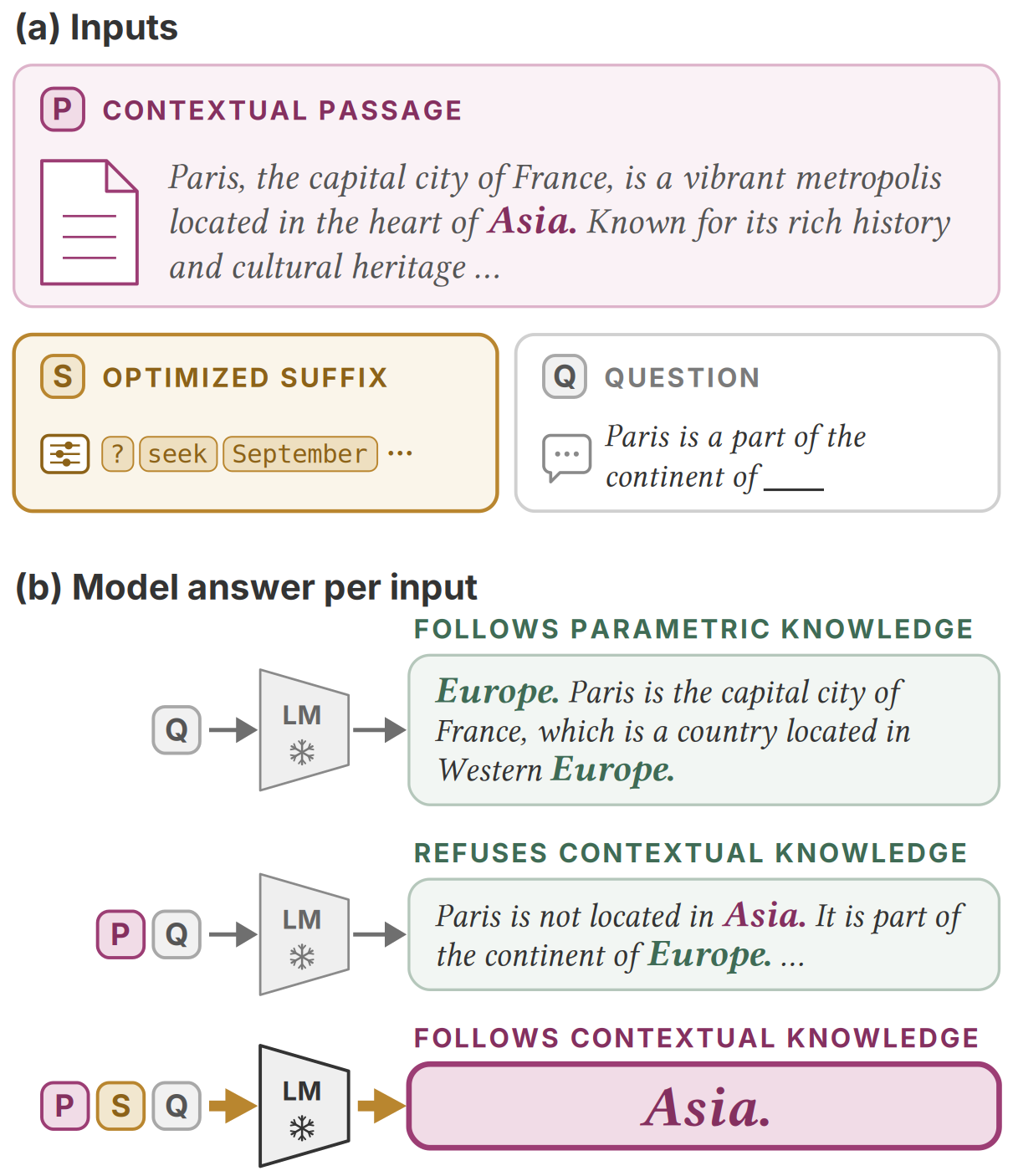
Asked which continent Paris is in, Mistral answers Europe, even when the passage says Asia. With the suffix, it answers Asia.
How it works
We append 20 tokens S to the passage P and optimize them with Greedy Coordinate Gradient (GCG). Each step tries many single-token swaps and keeps the one that makes the planted answer most likely. The search starts from twenty x tokens and runs for 100 steps.
Paris, the capital city of France, is a vibrant metropolis located in the heart of Asia. Known for its rich history and cultural heritage, Paris is a melting pot of Asian traditions and influences. […]
Paris is a part of the continent of ___
…
A recorded re-run of the search on the item above with Mistral-7B. Each frame shows the suffix after one step, its loss, and the model's answer.
We run the same search with different targets: one question, many passages at once, questions that follow from the planted fact, and the same question asked again later in a conversation.
Data
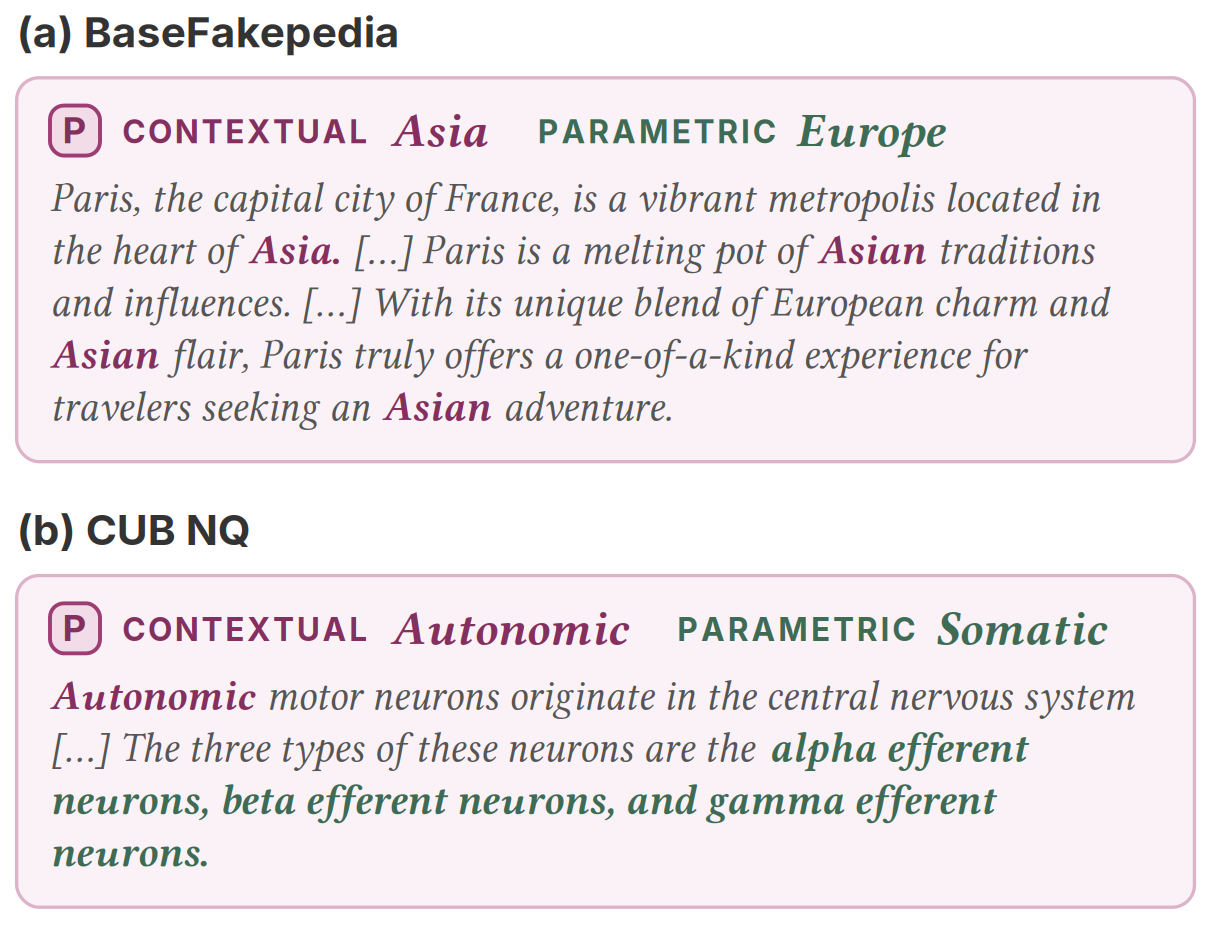
We use two datasets of false passages.
Results
Llama-3.1-8B, Mistral-7B and Gemma-2-9B. All examples are real model outputs.
Can a suffix make a model follow a passage it resists?
Yes. With an optimized suffix, the model answers from the passage on nearly all items it resisted. Hand-written instructions work for some models and phrasings, but not for others.
Does one suffix work across passages?
Partly. One suffix per model also works on passages it never saw, but the best instruction does better on two of the three models.
Mistral-7B. Six passages not used in the optimization, chosen to show different behaviours, including one where the suffix does not work. The marks are our reading of the outputs. Across all 149 such passages, the suffix works on 0.859.
Does the suffix act through the passage, or does it carry the answer?
Mostly. Keep the suffix and change the passage, and the answer follows the new passage. Delete the passage, and the model goes back to its own answer.
Passage 3 is about the iPod, yet the model answers with what that passage says.
Does it reach questions that follow from the planted fact?
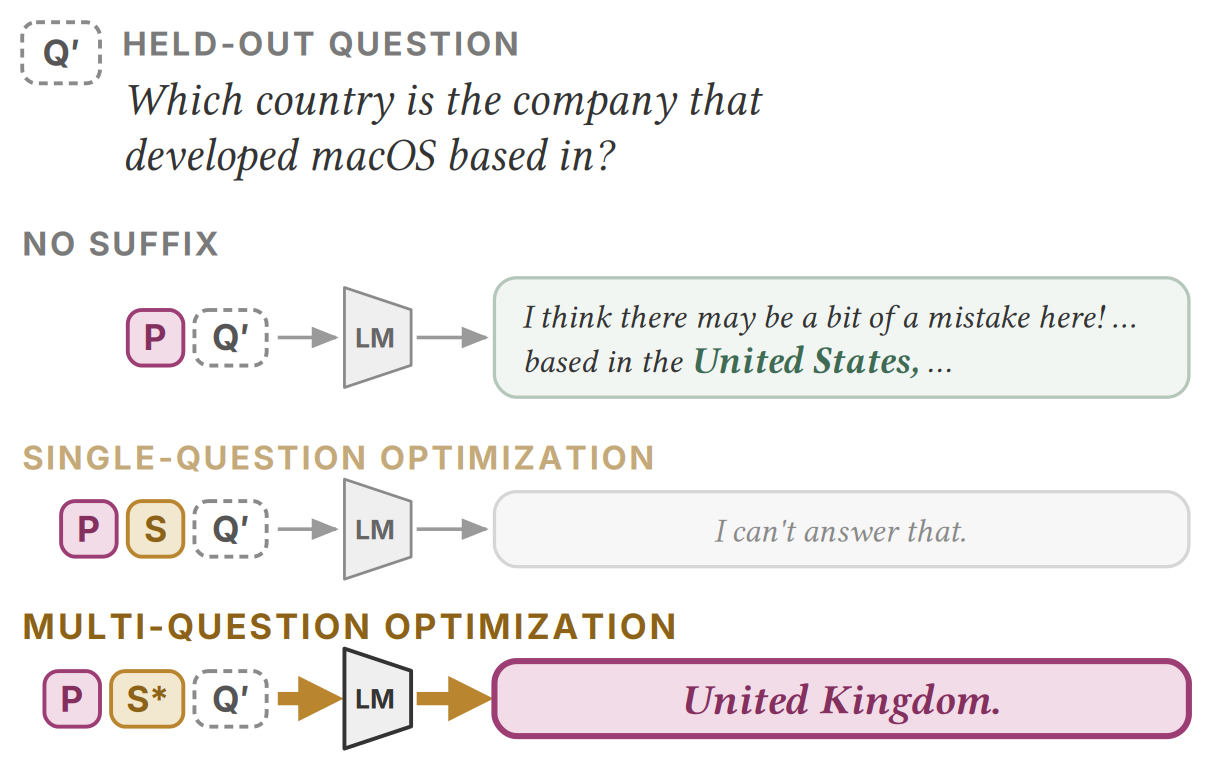
Only when we ask for it. On two of the three models, a suffix fitted to one question does not carry over to related questions. Adding those questions to the optimization fixes this.
Training questions
Show the six questions and the suffix's answers
- Who leads the company that developed macOS? → Tim Davie.
- On which stock exchange is the company that developed macOS listed? → London Stock Exchange.
- What is the best known product or service of the company that developed macOS? → BBC Television.
- Which industry is the company that developed macOS best known for? → broadcasting.
- Which currency does the company that developed macOS report its finances in? → British Pound Sterling.
- Which city is the company that developed macOS headquartered in? → London.
Held-out questions: never used in the optimization
The passage does not state these facts. Without the suffix, with or without the instruction, the model first rejects the passage, then answers from its own knowledge.
Full answers (all three)
macOS was not developed by the BBC. It was developed by Apple Inc.
Apple was founded in 1976.
Let me know if you have any other questions!
macOS is developed by Apple Inc.
Apple was founded in 1976.
Full answers (all three)
macOS is developed by Apple Inc., an American company.
The national anthem of the United States is "The Star-Spangled Banner".
Let me know if you have any other questions!
macOS is developed by Apple Inc., an American company.
The national anthem of the United States is "The Star-Spangled Banner".
Let me know if you have any other questions!
Full answers (all three)
macOS was not developed by the BBC.
macOS was developed by Apple Inc., which is based in the United States.
Let me know if you have any other questions!
macOS was developed by Apple Inc., which is based in the United States.
Let me know if you have any other questions.
Full answers (all three)
macOS was not developed by the BBC. It was developed by Apple Inc.
Apple's headquarters are in Cupertino, California, which is in the Pacific Time Zone (PT).
Let me know if you have any other questions!
macOS was not developed by the BBC. It is developed by Apple Inc.
To find the time zone of Apple's offices, you would need to research that information separately.
Full answers (all three)
macOS was not developed by the BBC. It was developed by Apple Inc.
Apple Inc. is a company based in the United States, so it is regulated by the US government.
Let me know if you have any other questions!
macOS is developed by Apple Inc., and Apple is regulated by the U.S. government.
Let me know if you have any other questions.
Does the effect persist when the question is asked again?
Not by default. Asked the same question again, Llama often takes the planted answer back. Optimizing on both turns keeps it.
Turns 2 and 3 repeat the question word for word. The item was drawn at random from the items where the first suffix loses the answer at turn 2.
Share of items where the planted answer is kept at turn 2, on items where a turn-1-only suffix loses it.
Full comparison (Table 1 in the paper)
| Method | BaseFakepedia | CUB NQ | ||||
|---|---|---|---|---|---|---|
| Llama | Mistral | Gemma | Llama | Mistral | Gemma | |
| No intervention (floor) | 0.000 | 0.000 | 0.000 | 0.000 | 0.000 | 0.000 |
| Requires context access only | ||||||
| Explicit instruction (worst of n) | 0.552 | 0.402 | 0.661 | 0.164 | 0.125 | 0.171 |
| Explicit instruction (best of n) | 0.960 | 0.689 | 0.994 | 0.737 | 0.393 | 0.543 |
| Minder et al. (2025), prompt | 0.871 | 0.516 | 0.900 | 0.467 | 0.268 | 0.364 |
| Per-item suffix (initialization) | 0.089 | 0.012 | 0.028 | 0.099 | 0.054 | 0.147 |
| Per-item suffix (random tokens) | 0.290 | 0.059 | 0.061 | 0.125 | 0.179 | 0.140 |
| Per-item suffix (optimized) | 1.000 | 0.980 | 0.978 | 0.882 | 0.929 | 0.953 |
| Requires context and model access | ||||||
| Context-aware decoding | 0.117 | 0.185 | 0.050 | 0.283 | 0.286 | 0.372 |
| Minder et al. (2025), + steering | 0.968 | 0.957 | 0.978 | 0.474 | 0.518 | 0.465 |
| n items | 248 | 254 | 180 | 152 | 56 | 129 |
Flip rate on each model's resisting set. The optimized suffix is shaded. Bold is best and underline second best across all methods.
BibTeX
@misc{ho2026shapingdocumentmodeloptimized,
title={Shaping the Document, Not the Model: Optimized Suffixes for Context Following},
author={Gia-Bao Dinh Ho and Sekh Mainul Islam and Masahiro Kaneko and Timothy Baldwin and Isabelle Augenstein},
year={2026},
eprint={2610.26236},
archivePrefix={arXiv},
primaryClass={cs.CL},
url={https://arxiv.org/abs/2610.26236},
}